
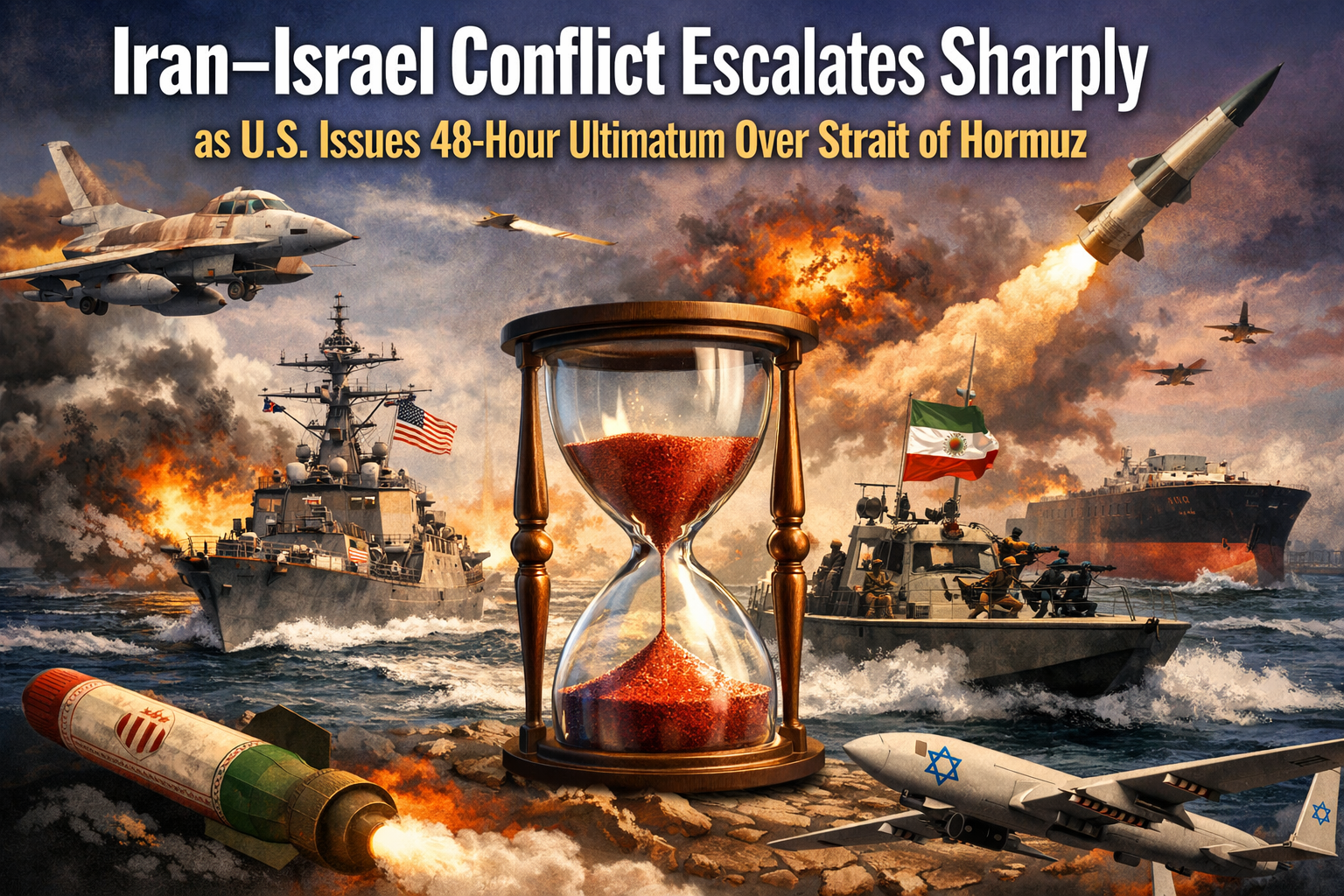
The Middle East is once again at the center of global attention after a dramatic escalation between Iran and Israel, raising fears of a wider regional war with global consequences. In the latest developments, the United States has reportedly issued Iran a 48-hour ultimatum to reopen the Strait of Hormuz, one of the world’s most critical oil shipping routes, while both Iran and Israel continue exchanging direct military strikes.
Why This Escalation Matters
The current confrontation is no longer being viewed as an isolated exchange of hostilities. Analysts warn that the combination of direct missile attacks, retaliatory airstrikes, and pressure on strategic maritime routes could trigger a much broader international crisis.
Iran has reportedly launched missile attacks toward Israel, leaving more than 100 people injured according to early reports. In response, Israel has carried out strikes targeting Tehran, marking a dangerous intensification in a conflict that had already pushed the region to the brink.
At the same time, the Strait of Hormuz has become a major flashpoint. The narrow waterway is essential for global energy markets, with a significant share of the world’s oil and gas shipments passing through it every day. Any prolonged disruption there could send energy prices soaring, destabilize financial markets, and increase political pressure on major world powers.
U.S. Ultimatum Raises Global Stakes
The reported 48-hour ultimatum from the United States adds a new and highly sensitive dimension to the crisis. Washington’s demand that Iran reopen the Strait of Hormuz signals that the issue is no longer only about regional military retaliation, but also about global trade, energy security, and international stability.
If the strait remains blocked or threatened, the consequences could be immediate:
- Higher global oil prices
- Supply chain disruptions
- Increased military presence in the Gulf
- Greater risk of direct involvement by world powers
- Rising volatility across international markets
This is why many observers now believe the Iran–Israel conflict could evolve into a broader geopolitical confrontation if diplomatic channels fail in the coming hours.
Iran and Israel Exchange Direct Blows
The latest reports suggest that Iran’s missile barrage caused significant injuries in Israel, with emergency services responding to multiple impact sites. Meanwhile, Israeli strikes on Tehran indicate that Israel is prepared to respond forcefully and directly rather than rely only on proxy confrontations.
This shift is especially significant because direct state-to-state attacks between Iran and Israel carry a much higher risk of uncontrolled escalation. Each new strike increases pressure for retaliation, making de-escalation more difficult.
Military experts warn that if attacks continue at this pace, neighboring countries and allied powers could be drawn in, either to defend strategic interests or to protect regional partners.
Could This Become a Global Conflict?
That is now the question dominating international headlines. While no major power has officially declared broader military involvement, the ingredients for a larger conflict are clearly present:
- Direct attacks between Iran and Israel
- U.S. pressure tied to a strategic maritime chokepoint
- Threats to global oil supply
- Rising instability across the Middle East
- High potential for miscalculation by multiple actors
A prolonged crisis would not only affect the region. Europe, Asia, and the United States would all feel the impact through energy markets, security concerns, and diplomatic fallout.
What Happens Next
The next 48 hours may prove decisive. If Iran refuses to comply with demands regarding the Strait of Hormuz and military exchanges continue, the world could face one of the most dangerous geopolitical moments in recent years.
For now, governments, markets, and international observers are watching closely. The hope remains that urgent diplomacy can prevent a full-scale regional war. But with missiles already launched, Tehran struck, and global energy routes under threat, the margin for error is rapidly disappearing.
Final Takeaway
The Iran–Israel conflict has entered a far more dangerous phase. With over 100 reported injuries in Israel, strikes reaching Tehran, and the United States issuing a 48-hour ultimatum over the Strait of Hormuz, the crisis is no longer just regional. It has become a global concern with the potential to reshape energy markets, security alliances, and international stability.
If tensions continue to rise, this could become one of the defining geopolitical crises of the year.


